5 October 2026
Food-Upcycled Olivoil Emulsifiers for Clean Beauty
The Potential of Olive Oil
The skincare industry keeps changing in light of the growing trends of eco-friendliness and consumer interest in social responsibility. The ethical sourcing of natural ingredients plays a relevant role in boosting the sustainability and cleanliness of beauty products.
These consumer needs go together with the goal of improving the effectiveness, safety and mildness of skin care products. They meet the multi-faceted functional targets required by an increasingly diversified user base, and the need to comply with the new trend of skinimalism.
Olive Oil Fatty Acids: The Innovation Core
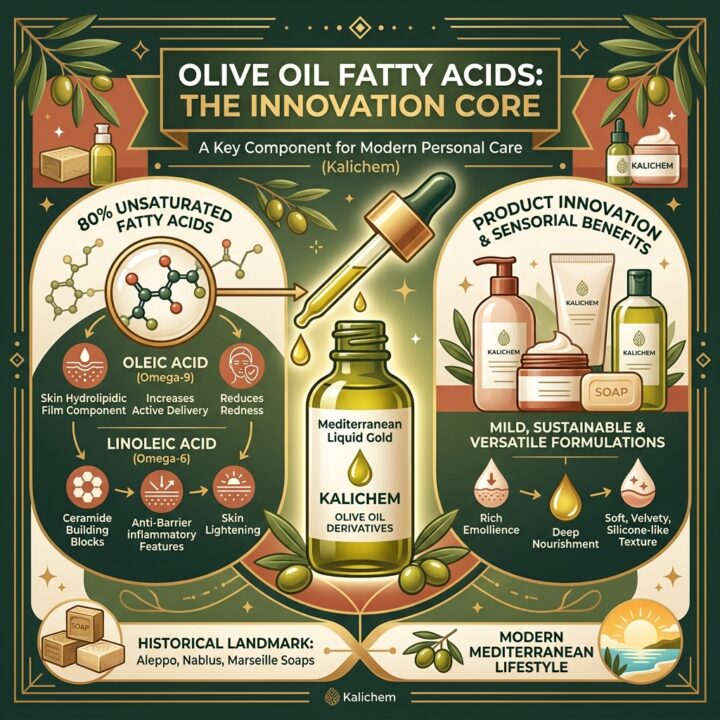
Olive oil and its fatty acids fully address these needs. Besides being an icon of the modern Mediterranean lifestyle and diet, olive oil represents a historical landmark in the cosmetics industry. It is a key component of the most ancient soaps developed by mankind (Aleppo, Nablus and Marseille soaps), as well as a vital ingredient of the beauty routine in the Greco-Roman era. This Mediterranean “liquid gold” is the ideal base for formulating mild, sustainable and versatile personal care products, thanks to its unsaponifiable fraction and, above all, its fatty acid composition.
Olive oil fatty acids are made of approximately 80% unsaturated fatty acids, mainly oleic acid and linoleic acid.
- Oleic acid is among the most frequently occurring fatty acids found in the skin hydrolipidic film and sebum, with proven features in increasing the delivery of specific active ingredients by modulating skin permeability. It has proven activity as a pharmaceutical delivery system thanks to its fluid and flexible structure, easily melted to the skin surface, along with skin redness reduction properties.
- Linoleic acid is known as one of the most relevant building blocks for skin ceramides, with objectified anti-inflammatory and skin lightening features.
The combination of these unsaturated fats underlies the unique beneficial biological actions of olive oil on skin barrier restoring. It also explains the unique sensorial profile that emulsifiers and surfactants based on olive oil fatty acids show on the skin, in terms of emollience, nourishment, and a soft, velvety, silicone-like texture.
Olivoil: Kalichem's Emulsifiers from Upcycled Olives
Kalichem’s Olivoil specialities are patented emulsifiers and surfactants obtained from olives upcycled from the food industry, where the fatty acids described above are condensed with vegetable-derived polypeptides, amino acids or sugars. The result is original macro-molecules with unique technical, sensorial and functional profiles.
The Olivoil family includes patented emulsifiers approved by Cosmos and Natrue. The main references are:
|
|
Olivoil Glutamate Emulsifier G-PF |
Olivoil Avenate Emulsifier |
|
EU INCI |
Sodium Olivoyl Glutamate (SOG) |
Potassium Olivoyl Hydrolyzed Oat Protein (POHOP) |
|
Composition |
Fatty acids from olive and sugar beet-derived glutamic acid |
Olive fatty acids functionalized with oat-derived polypeptides |
|
ISO 16128 natural origin content |
100% |
>90% |
|
Associated vegetable lipid waxes |
100% palm-free |
Derived from sustainable palm oil |
Both lipo-aminoacid/polypeptide components are associated with vegetable-derived lipid waxes to form self-emulsifying bases. These bases can structure emulsions of different nature and incorporate from low to high quantities of oily phase (up to a maximum of 50%).
Lamellar Liquid Crystal Emulsions: Structure and Sensorial Profile
The emulsions formed by both references are oil-in-water lamellar liquid crystal systems. They contain small-sized oily phase droplets (on average <2 μm for emulsions loaded with an overall 25-30% of oily phase) and boast a peculiar dermo-compatibility profile. They promote a consistent skin barrier restoring action, a “second skin” effect and a unique, silicone-like texture.
Depending on the emulsifier concentration of use and the surrounding formulation excipients, specifically vegetable polymers like xanthan gum or cellulose derivatives as well as consistency factors, these structured lamellar systems support the development of:
- hyper-fluid/sprayable emulsions;
- creams with high viscosity loaded with minerals, pigments and sunscreen filters.
Skin Barrier Restoring and Mildness Tests
Both Potassium Olivoyl Hydrolyzed Oat Protein (POHOP) and Sodium Olivoyl Glutamate (SOG) were proven to promote a restorative action on the skin barrier. The aim of the studies was to evaluate and compare the irritant effect on the skin of both molecules following a single application, using an occlusive patch test and a trans-epidermal water loss (TEWL) assessment.
How the Tests Were Carried Out
Twenty healthy volunteers were selected and a patch was applied on the forearms for 24 hours. The patch contained six cells in which the aqueous solutions of the molecules to be tested were loaded.
- POHOP was tested in several aqueous solutions, all concentrated at 10% active matter: alone, and in combination with Sodium Laureth Sulfate (SLES) at a ratio of 9.5 SLES : 0.5 POHOP, compared with a solution containing only SLES as control. The aim of this specific study was to evaluate the mildness of the POHOP molecule and how it impacts the mildness of formulations containing significant amounts of aggressive ingredients like SLES.
- SOG was applied as a 5% aqueous solution. Additional solutions were applied to the volunteers: a 5% aqueous solution of SLES as positive control, physiological water as negative control, and a 5% aqueous solution of decyl glucoside as competitor.
The irritant effect was detected by measuring TEWL and the erythema index in the areas of interest before the start of treatment (T0) and 60 minutes after removal of the patch (T24 hours). All the data obtained were interpreted by an appropriate statistical analysis.
Measurement Tools
A DermaLab Combo skin analysis system made by Cortex was used.
- Erythema index: the instrument is equipped with a probe with a microchip able to measure the colour of the skin in standardized conditions. The colour is detected and expressed according to the CIE-L*a*b* coordinates and, through a mathematical function that combines different parameters, the software calculates the erythema index, which represents a measure of the redness level of the skin. By measuring the redness index variations at times T0 and T24 hours, it is possible to evaluate the irritating effect of the applied products: the higher the redness value after treatment compared to T0, the greater the irritating potential of the applied substance.
- TEWL: a high level of TEWL may indicate damage to the skin barrier, which can be caused by chemicals, physical insult or pathological conditions. TEWL rates increase in proportion to the level of damage. By measuring the water loss variations at times T0 and T24 hours, it is possible to evaluate the ability of a substance to damage the skin barrier and therefore to exert an irritating action on the skin.
Results
- Olivoil Avenate Emulsifier (POHOP): when used alone, it shows a TEWL value matching the score of physiological water and inferior by almost 100% compared to the values detected with the same amounts of SLES. When used at 0.5% a.m. in the presence of 9.5% SLES, it reduces the SLES-related water transpiration by more than 50%.
- Olivoil Glutamate Emulsifier (SOG): proved to be non-aggressive, showing the best score among the substances object of the study, including a benchmark of well-known mildness. The same results pattern was observed for the erythema index value.
Applications: From Serums to Body Butters
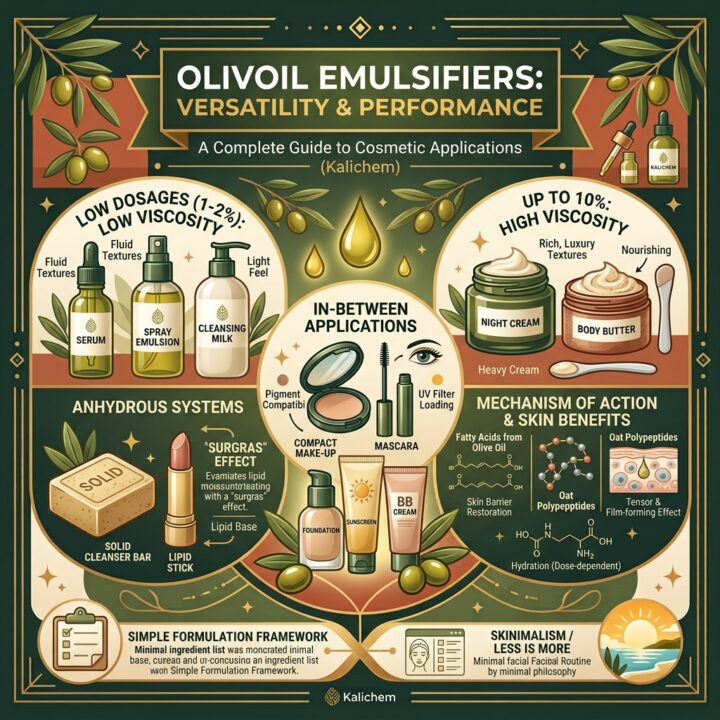
Olivoil emulsifiers enable the formulation of dermo-compatible and extremely mild emulsions in a wide variety of cosmetic applications, according to the concentrations of use and the excipients used. They show a totally unusual versatility of use for vegetable-derived self-emulsifying bases.
- Low dosages (1-2%): low viscosity products such as serums, sprayable emulsions, roll-on deodorants and cleansing milks.
- Up to a maximum of 10%: high viscosity formulas such as rich night creams or body butters.
- In-between applications: make-up formulations, including mascara, foundations, coloured creams, BB creams and sunscreen emulsions loaded with both organic and inorganic filters.
- Anhydrous systems: solid cleansers and bars with a “surgras” effect, as well as lipid sticks.
The skin barrier restoring action promoted by the unique composition of unsaturated fatty acids from olive oil, the tensor/film-forming effects of oat polypeptides and the moisturizing properties of glutamic acid give each of these applications a unique sensory profile. This means a silicone-like after-feel, dose-dependent hydration and emollience (“second skin” effect), and sophisticated, luxury textures while maintaining a simple formulation framework with few ingredients required, in line with the trend of skinimalism and the “less is more” philosophy.
How to Use Olivoil Emulsifiers
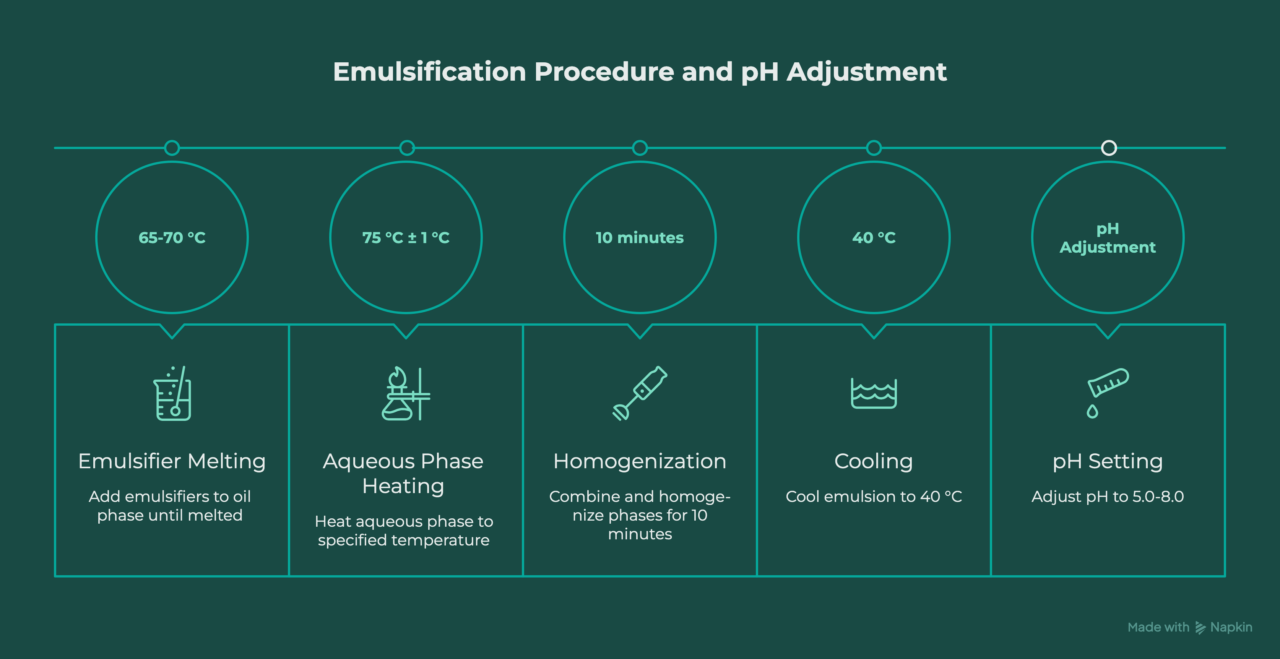
The method of use is also characterized by marked versatility. After adding the emulsifiers to the oil phase until the melting point (about 65-70 °C), it is possible to use either method:
- Direct emulsification: the whole melted oily phase is added to the aqueous phase.
- Indirect emulsification: one-third of the aqueous phase is added beforehand to the oily phase containing the emulsifier, to form an extemporary water-in-oil emulsion. After a few minutes, the remaining two-thirds of the aqueous phase is added to generate the phase inversion.
The pH of use varies between a suggested minimum value of 5.0 and higher alkaline values (8.0).
For the example formulations, the procedure is: mix phase A ingredients and heat until solids fusion; mix phase B ingredients and heat to 75 °C ± 1 °C; combine phases A and B, stir and homogenize for 10 minutes; cool down to 40 °C; add the remaining phases, homogenizing after each addition; finally, set the pH within a range of 5.0-8.0.
Conclusion: A Green Solution for Clean Beauty
In compliance with the latest trends, where sustainability, ethics and cleanliness concepts merge, the food-upcycled Olivoil emulsifiers represent a green breakthrough solution. They enable the development of a wide variety of cosmetic applications with a peculiar silicone-like texture and proven skin barrier restoring features.
The patented references Olivoil Avenate Emulsifier (with POHOP as main emulsifying unit) and the 100% palm-free Olivoil Glutamate Emulsifier G-PF (SOG) were designed through the combination of ingredients with proven functional added value, to obtain oil-in-water anionic emulsifiers. They build stable lamellar liquid crystal systems and emulsions with variable characteristics and sophisticated texture, fully aligned with the skinimalism trend. They make it possible to build a technologically advanced sensorial profile while reducing the amount of raw materials in the formula, with consistent functional benefits on skin barrier integrity restoring and a significant tensor effect and hydration properties.
Are Olivoil emulsifiers certified?
They are approved by Cosmos and Natrue. Olivoil Glutamate Emulsifier G-PF has an ISO 16128 natural origin content of 100%, while Olivoil Avenate Emulsifier has more than 90%.
What is the difference between Olivoil Glutamate G-PF and Olivoil Avenate?
Glutamate G-PF (Sodium Olivoyl Glutamate) uses sugar beet-derived glutamic acid and is 100% palm-free. Avenate (Potassium Olivoyl Hydrolyzed Oat Protein) uses oat-derived polypeptides and waxes derived from sustainable palm oil.
Which cosmetic products can be formulated with Olivoil?
Serums, sprays, roll-on deodorants, cleansing milks, night creams, body butters, make-up (mascara, foundations, BB creams), sunscreen emulsions, solid cleansers and lipid sticks.
What dosages are recommended?
From 1-2% for low viscosity products, up to a maximum of 10% for high viscosity formulas. The oily phase can reach up to 50%.